Welcome to KAMA Auto
CNG Light Trucks for City Delivery: Route and Payload Guide
A CNG light truck is worth evaluating when its delivery route has dependable refuelling access, the finished vehicle can carry the required load, and a local workshop can support its gas system. Start with a working route and a loaded vehicle assessment—not a nationwide vehicle count or a promise of universal savings.
For distributors serving Nigeria, Colombia and other markets with natural-gas vehicle activity, the useful question is specific: can this truck complete the customer's busiest delivery day, including a disruption at its usual filling station?
What the 2026 news means for delivery fleets
Nigeria's Pi-CNG & EV programme currently reports 105 refuelling stations across 24 states and the Federal Capital Territory. That is a reason to investigate individual delivery corridors, not proof that every depot has convenient access. Check the station that would actually serve the fleet, its operating hours and its ability to accommodate the truck.
In Colombia, Vanti announced a natural-gas urban beverage-delivery vehicle with Postobón, DFAC–Dongfeng and Ecopetrol in March 2026. The project announcement provides a relevant application example: repeated distribution routes. It is not evidence of KAMA deliveries, equivalent specifications or approval of another vehicle.
These developments support route-level evaluation. They do not establish CNG light-truck sales volumes or predict demand for a particular model. For broader market and importer considerations, read our CNG commercial vehicle importer overview. This guide focuses on the delivery-day checks that follow.
1. Map the delivery route and its refuelling fallback
Build a route sheet with the depot, delivery stops, total distance, steep sections, loading points and return journey. Add the station detour rather than treating refuelling as if it happens on the route. Visit the proposed station during the fleet's intended operating period.
| Check | Evidence to collect | Decision it supports |
|---|---|---|
| Primary station | Truck access, opening hours, queue observations and compatible filling arrangements | Whether refuelling fits the dispatch schedule |
| Backup station | Alternative location, detour distance and current operating status | Whether a station outage can be managed |
| Longest working day | Loaded distance, empty return, diversions and waiting periods | The duty cycle the vehicle must demonstrate |
| Busy delivery window | Stop duration, loading time and station waiting time | Whether deliveries remain achievable |
A station shown on a map is a lead to verify, not a guarantee of supply. In Nigeria, begin with the programme's infrastructure information and confirm the actual station. In Colombia, ask the local gas supplier and fleet operator about the intended corridor. Apply the same method in Peru, Argentina or Egypt rather than assuming countrywide suitability.
2. Distinguish dedicated CNG, bi-fuel and dual-fuel
The Alternative Fuels Data Center distinguishes dedicated vehicles, which use natural gas only, from bi-fuel vehicles, which can operate on natural gas or gasoline through separate fuel systems. It uses “dual-fuel” for systems combining natural gas with diesel ignition assistance. These terms should not be interchanged in a configuration enquiry.
For a dedicated CNG truck, verify the refuelling plan before committing to the route. For a CNG/gasoline truck, ask the supplier to document starting, fuel selection, switching conditions and the usable capacity of each system. Do not assume automatic switching or a combined driving range from a short catalogue label.
Gasoline operation may provide a fallback on a compatible bi-fuel vehicle, but it does not make an unreliable CNG route suitable by itself. Record how often the fleet would need the fallback and evaluate that actual operating pattern.
3. Compare CNG vs diesel vs gasoline on the same job
Use equivalent cargo bodies and representative loads. A comparison between an empty CNG chassis and a loaded diesel delivery vehicle will not help a buyer choose. Record fuel consumption in its original unit and compare operation over the same route; do not treat a litre of liquid fuel as equivalent to a kilogram or cubic metre of gas.
-
Route completion: measure whether each configuration completes the loaded day and returns with the agreed operating reserve.
-
Working performance: observe loaded hill starts, acceleration into traffic and manoeuvring at delivery points.
-
Refuelling time: include queues and detours, not just time connected to a dispenser.
-
Maintenance support: identify a workshop, diagnostic capability and parts supply for the exact engine and fuel system.
Keep the results specific to the tested configuration and conditions. A fuel type alone cannot establish payload, hill-climbing performance or real-world range.
4. Check usable payload after the body and fuel system are fitted
Ask for the finished vehicle's permitted gross mass, axle limits and actual operating empty mass. Account for the driver, crew, fuel, tools, spare equipment and fitted body when establishing the goods load. State what is already included in the weighing record so that items are not counted twice.
Gas cylinders and their installation occupy space and add mass. Check mounting clearance, access for inspection and compatibility with the body. Do not apply a generic payload-loss percentage: use the selected vehicle's documents and a finished-vehicle weighing result. Check axle loads as well as total mass.
For packaged beverages or other dense freight, the loading limit may be reached before the cargo area is full. For parcels, door openings and usable volume may matter first. Specify the normal and maximum load, not only an advertised tonne class.
5. Identify the exact KAMA configuration
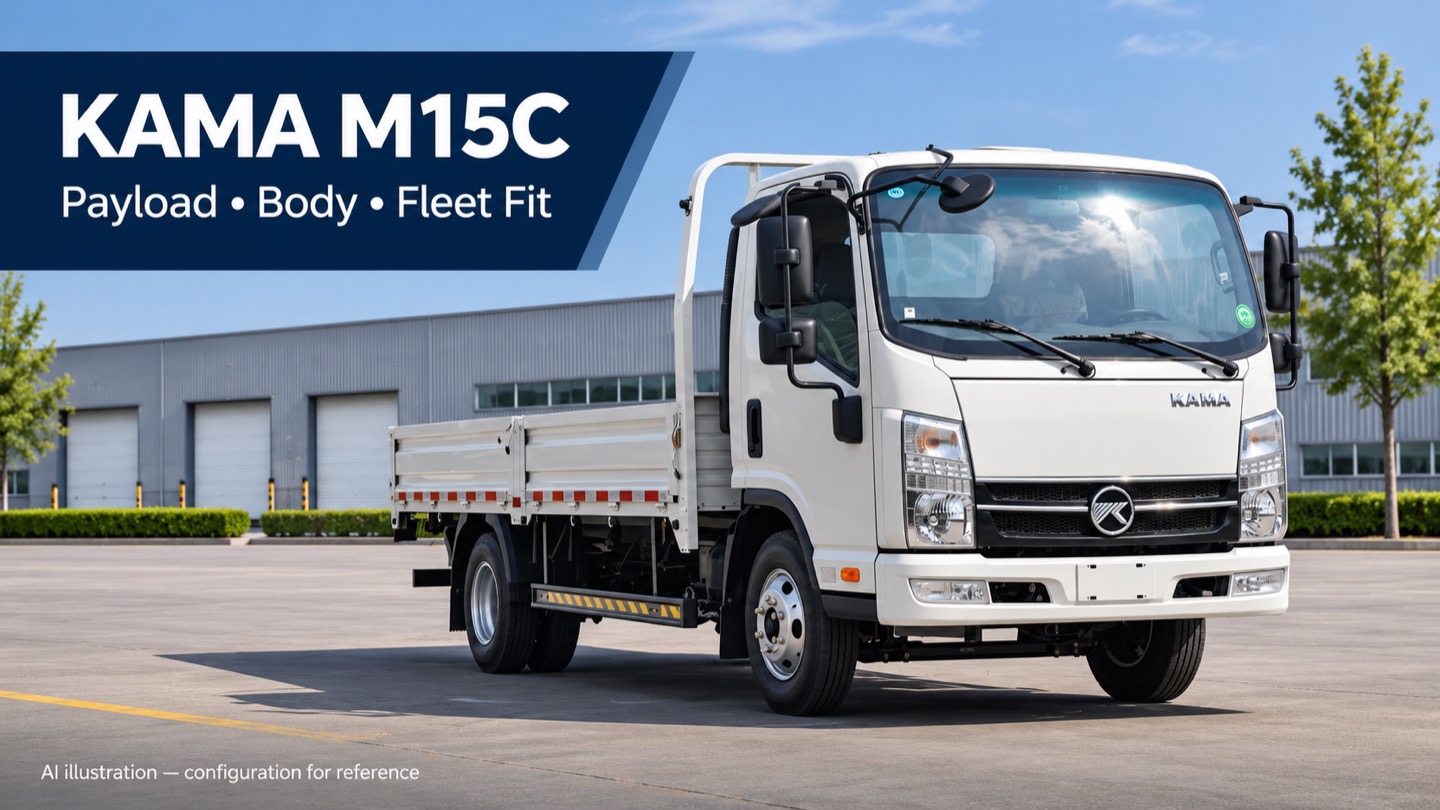
The KAMA M3 series product page includes the M36 gasoline-and-CNG version. The matching configuration sheet identifies M36 as a single-cabin vehicle with a suggested 3-ton payload. That suggested class is a starting point for discussion, not confirmation of the usable payload or registration eligibility of every finished vehicle.
Request the M36-specific configuration and operating documents. Other M3 variants use different powertrains; the series name alone does not identify a CNG vehicle. A listing for gasoline and CNG does not, by itself, establish how fuel switching works or the range available on either fuel.
Buyers considering a smaller vehicle can also review the KAMA X-Series light-truck range. Specify the required fuel configuration and request a matching current sheet before comparing it with M36.
6. Use a delivery trial with written acceptance criteria
Before expanding a fleet, agree a representative trial with the supplier and local operator. Use the intended body and cargo, include the longest normal route, and document weather, traffic and refuelling conditions. This is a proposed evaluation method, not a claim that KAMA has completed a test on the buyer's route.
-
Identify the exact vehicle, body, fuel system and load used.
-
Record departure and return readings, distance and fuel replenishment.
-
Log delivery completion, station detours and waiting time.
-
Review the fallback plan and the supplier's operating instructions.
-
Agree whether the results meet the customer's route, payload and service requirements.
Also request cylinder identification, applicable approval documents, inspection requirements and service-life information. Have the local registration and inspection specialists confirm their applicability to the destination and exact vehicle. A general emissions label or cylinder document should not be treated as automatic whole-vehicle approval.
Frequently asked questions
How much range will a CNG cargo truck deliver?
There is no single figure for the vehicle category. Ask for configuration-specific evidence and test the loaded route. Cylinder water volume alone is not a usable-gas or distance figure.
Does a CNG/gasoline truck use both fuels at once?
A bi-fuel system normally refers to operation on either fuel. Confirm the actual supplier's system description and operating instructions; do not confuse it with a natural-gas/diesel dual-fuel system.
Can the same truck be supplied for every destination?
Fuel availability does not establish import or registration eligibility. Confirm steering position, emissions configuration, gas-system documentation and local service support for the destination before selecting the vehicle.
Send KAMA a route-based vehicle enquiry
Provide your country and city, delivery use, daily route distance, normal and maximum goods load, cargo-body needs, primary and backup refuelling locations, required quantity and LHD/RHD preference. State whether you are a distributor or fleet operator and identify any required documents.
Contact KAMA for a configuration review, or use the enquiry form on the M3 product page. Ask for the exact model and fuel-system specification before arranging a vehicle evaluation.