Welcome to KAMA Auto
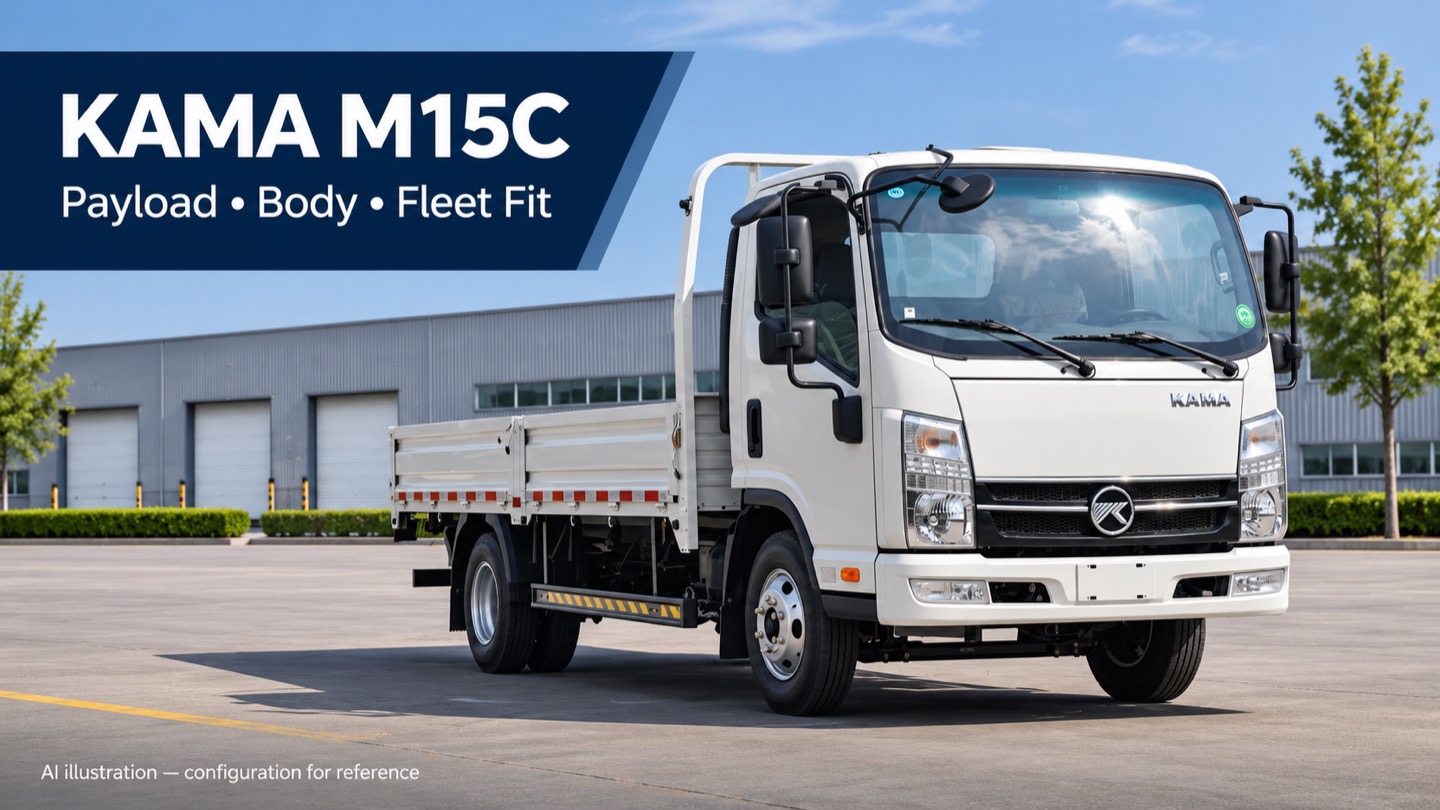
KAMA M15C Diesel Light Truck: Payload, Body and Fleet Fit
The KAMA M15C is a diesel light-truck candidate for distributors and fleets that need a single-cab vehicle in the suggested 3-ton load class. Its suitability depends on the finished body, actual goods load, loading method and route. Before ordering, confirm the usable payload of the selected build rather than treating a catalogue load class as a guarantee for every application.
This guide explains how to turn the published M15C specifications into a practical fleet enquiry. It complements the KAMA M15C product specification page.
M15C configuration reference
| Item | Listed configuration |
|---|---|
| Fuel and engine displacement | Diesel, 2771 cc |
| Transmission | 5+1 manual |
| Cabin | Single cabin |
| Suggested payload | 3 tons; verify the finished configuration |
| Wheelbase | 2860 mm |
| Cargo box dimensions | 3600 × 1860 × 400 mm |
| Steering shown on the product page | Left-hand drive |
| Base emissions specification | Euro III |
These figures describe the referenced configuration. They do not establish the dimensions or payload of a different enclosed or refrigerated body, or eligibility for registration in a particular country.
Start with goods weight and loading access
Describe the normal and heaviest delivery load, including packaging, pallets and returnable containers. Dense goods and bulky parcels create different requirements. Measure the packed load and check whether the proposed body accommodates it without exceeding the permitted mass or axle limits. Do not estimate usable internal volume from an external body dimension.
Explain how goods will be loaded: by hand, forklift or loading dock. Ask for opening dimensions, deck height and loading access for the exact body. A body that accommodates the goods may still be unsuitable if the customer cannot load it efficiently at the destination.
Compare bodies without carrying over the payload figure
The product range lists open cargo, enclosed box and refrigerated body options, subject to configuration confirmation. An open body can suit goods that do not require an enclosed compartment. An enclosed body needs checks for door clearance and usable internal space. A refrigerated application also needs a defined cargo-temperature requirement, insulation specification and refrigeration-system proposal.
For each build, request the finished vehicle's operating empty mass and permitted gross and axle masses. Establish which items are included in the weighing record: body, equipment, fuel, crew and tools. Account for any remaining operating items before calculating the goods allowance. Do not deduct the body a second time if it is already included in the finished-vehicle mass.
Check load distribution as well as total mass. Heavy equipment and the position of concentrated cargo can affect individual axle loads. Ask the body supplier to confirm the planned layout, then verify the completed vehicle. The suggested 3-ton figure must not automatically become a refrigerated truck's goods allowance.
A fleet selection checklist
| Check | Information to provide or request |
|---|---|
| Cargo | Goods type, normal and maximum weight, packed dimensions and handling needs |
| Body | Required openings, usable internal dimensions, equipment and finished mass |
| Loading | Hand, forklift or dock access; loading-site constraints |
| Axles | Permitted axle masses and proposed load distribution |
| Route | Daily distance, gradients, road surface, altitude and delivery stops |
| Service | Workshop capability, diagnostics and a model-specific parts plan |
| Destination | Steering, emissions and documentation requirements confirmed locally |
Assess the working route and service plan
Engine displacement and gearbox description alone cannot establish loaded hill performance or fuel consumption. Give the supplier a realistic route description and request configuration-specific evidence. If arranging a trial, agree the body, load, route and acceptance criteria beforehand. Record traffic and operating conditions so that the results can be interpreted correctly.
For distributors, prepare a parts and service plan for the exact engine and chassis variant. Identify which workshop will perform maintenance, what information technicians need and how replacement parts will be identified. For fleet buyers, confirm the support arrangements with the supplying distributor before committing to multiple vehicles.
Match the destination before placing an order
The reference vehicle is listed as left-hand drive with a Euro III base specification. These labels do not confirm import or registration acceptance in any specific market. Verify current requirements with the appropriate local authority or qualified importer and ask for documents matching the proposed vehicle. State a right-hand-drive requirement explicitly; do not assume that version is available.
If the required load, steering arrangement or body does not match, compare the KAMA fuel light-truck range before selecting a model. A different configuration should be assessed on its own evidence.
Frequently asked questions
Is the suggested 3-ton load valid for every M15C body?
No. Confirm the finished vehicle's goods allowance, operating mass and axle limits for the selected body and equipment.
Can I use the listed cargo-box dimensions for a refrigerated build?
No. Request the refrigerated body's usable internal dimensions and door opening separately. Insulation and equipment affect both space and mass.
What should a distributor send with the first enquiry?
Provide the destination country, intended use, normal and maximum cargo weight, required body, route information, quantity and steering requirement. Include any locally required vehicle documents.
Discuss your M15C configuration
Contact KAMA with your fleet requirements and ask for a configuration-specific response. Confirm the vehicle, body and destination requirements together before finalising your selection.