Welcome to KAMA Auto
Why Distributors Are Choosing Chinese LFP Electric Vans and Mini Trucks in 2026 — KAMA EW1 Review
Why Distributors Are Choosing Chinese LFP Electric Vans and Mini Trucks in 2026 — KAMA EW1 in Focus
Something significant happened in the global electric commercial vehicle market in March 2026: Ford Europe unveiled the Transit City, an all-electric van built entirely in China by its joint venture partner Jiangling Motors. The decision sent a clear message to the industry — Chinese LFP electric vans have reached a level of quality, cost-efficiency, and practicality that even Western OEMs are now choosing to distribute rather than compete with.
For importers, fleet operators, and distributors across Africa, Southeast Asia, the Middle East, and South America who have been evaluating Chinese electric commercial vehicles, this moment matters. It confirms what many have already discovered through direct sourcing: the best value in electric mini trucks and electric cargo vans today comes from Chinese manufacturers building on LFP battery platforms — at factory-direct prices, with export-ready specifications, and with 5-year battery warranties already standard.
KAMA Automobile's EW1 Electric Mini Cargo Truck is one of those vehicles. This article breaks down why it's attracting serious attention from distributors in 2026, and what makes it stand out against the broader market of Chinese electric commercial vehicles.
Why LFP Battery Technology Is Winning the Electric Van Market in 2026
The Ford Transit City, the Farizon SuperVan, and now the KAMA EW1 all share one key technical choice: lithium iron phosphate (LFP) battery chemistry. This is not a coincidence.
LFP batteries have become the preferred technology for electric commercial vehicles destined for emerging and mid-temperature markets for three well-documented reasons:
Thermal stability — LFP cells are significantly less prone to thermal runaway than NMC (nickel manganese cobalt) alternatives. In markets where ambient temperatures regularly exceed 35°C — which describes most of Africa, the Middle East, South Asia, and Southeast Asia — this matters operationally. It means fewer thermal events, more predictable degradation, and safer long-term fleet operation.
Cycle life — LFP batteries typically sustain 2,000–3,000 charge cycles before meaningful capacity degradation, compared with 1,000–1,500 cycles for NMC. For a delivery van that charges once per day, that difference translates to 5–8 years of reliable daily operation versus 3–4. This is precisely why Ford chose LFP for the Transit City's 56 kWh pack — and why KAMA has built the EW1 around a GOTION LFP cell.
Total cost of ownership — LFP cells cost less to produce than NMC, and that saving is increasingly passed through to buyers at the commercial vehicle level. Chinese manufacturers building at scale on LFP platforms are delivering electric mini trucks at price points that make the 3–5 year TCO calculation strongly favor electric over diesel in most emerging markets — even without government subsidies.
The global cargo van market is currently valued at over $900 billion and growing. Electric variants are still a minority — ICE vans hold roughly 60% share as of 2026 — but the rate of fleet conversion is accelerating in every region where fuel prices are rising and urban emission standards are being introduced. Distributors who establish LFP electric van portfolios now are positioning themselves ahead of a transition that industry data projects will reshape the segment entirely by 2033.
The KAMA EW1: Specifications That Match Real-World Distribution Needs
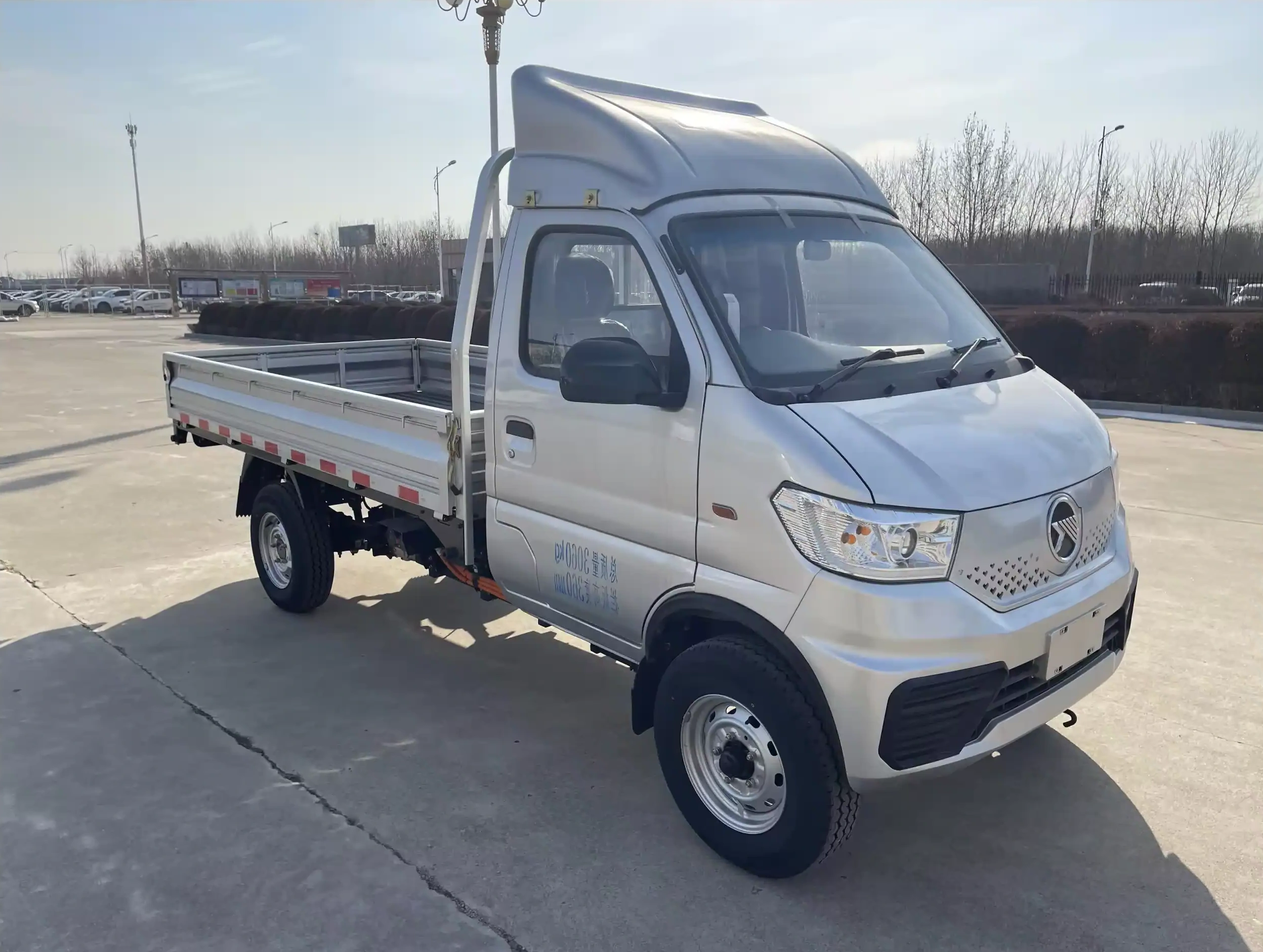
The KAMA EW1 is a 1-ton single cabin left-hand drive electric mini cargo truck, purpose-built for urban delivery, last-mile logistics, and light commercial transport in overseas markets. Here is what the specifications actually mean for a distributor evaluating it against competing options:
Payload: 1,000 kg / GVW: 2,700 kg
A 1-ton payload covers the daily working load of the vast majority of small and medium business delivery operations — market goods distribution, agricultural produce, building materials for small contractors, retail delivery, courier parcels, and light industrial supply. The EW1 is not an oversized vehicle for light tasks; it is correctly sized for the applications it targets.
Range: 180 km standard / up to 430 km with optional battery upgrade
The standard 24.01 kWh GOTION LFP pack delivers a confirmed WLTP range of 180 km. Industry data from Ford's own connected vehicle fleet analysis shows that 90% of vans in this segment average under 110 km per day. The EW1's standard range covers that duty cycle with meaningful margin. For distributors in markets with less charging infrastructure, or for fleet operators running longer inter-city routes, KAMA's 36.8 kWh battery upgrade extends the EW1's range to 430 km — one of the widest range options available in the 1-ton electric mini truck segment.
Motor: INOVANCE 35 kW continuous / 70 kW peak
INOVANCE is one of China's most established electric motor and drive system suppliers, with technology deployed across automotive, industrial, and commercial vehicle platforms. Specifying INOVANCE in the EW1 provides buyers with supply chain confidence and aftermarket parts access that generic motor suppliers cannot match.
Dimensions: 4,290 × 1,690 × 2,030 mm / Wheelbase: 2,500 mm
The EW1 is compact enough to navigate urban streets and tight delivery zones, while carrying a flatbed cargo box of 2,350 × 1,600 × 360 mm. For buyers requiring an enclosed box body, KAMA offers a PVC or metal cargo box upgrade (2,500 × 1,650 × 1,600 mm) as a factory option.
Charging: GBT fast and slow / CCS2 optional
Standard GBT charging supports both fast and slow charge. For distributors targeting markets where CCS2 (European standard) infrastructure dominates, the CCS2 port is available as a factory-fitted option. This makes the EW1 genuinely deployable across markets from West Africa to Southeast Asia to the Middle East without requiring aftermarket charging modifications.
Warranty: 5 years / 200,000 km on motor, battery and controller
This is the specification that separates serious electric commercial vehicle manufacturers from price-only suppliers. A 5-year / 200,000 km warranty on the three most critical EV components — motor, battery, controller — provides fleet buyers and end customers with the assurance needed to commit to electric conversion at scale. KAMA backs this with a 2-year / 40,000 km whole-vehicle warranty on top.
How the EW1 Compares to the Broader Market of Chinese Electric Vans in 2026
The Chinese electric commercial vehicle export market in 2026 is larger and more competitive than it was 24 months ago. Buyers sourcing electric mini trucks and cargo vans directly from China now have multiple options. Understanding where the EW1 sits within that market helps distributors make a more informed evaluation.
Against entry-level Chinese electric mini trucks (sub-$10,000 price point): The EW1 is not positioned as the cheapest option. Entry-level Chinese electric mini trucks at the sub-$10,000 price point typically use lower-grade LFP cells with 30,000–50,000 km battery warranties, anonymous motor suppliers, and limited overseas export certification support. For distributors building a fleet product they can service and stand behind, that warranty gap is commercially significant.
Against mid-market Chinese electric cargo vans (DFSK EC75, Ruichi range): These vehicles offer competitive range and payload at accessible price points, and have established some market presence, particularly in Southeast Asia. The EW1 differentiates on battery range flexibility (the 430 km upgrade option is unusual in this class), SINOMACH supply chain backing, and the option for factory SKD/CKD packaging — which directly reduces import costs for buyers in markets with assembly policies.
Against the Ford Transit City (JMC platform): The Ford Transit City is a mid-sized van (56 kWh, 110 kW, WLTP 254 km, payload up to 1,275 kg) positioned for the European market and priced accordingly. The KAMA EW1 targets the 1-ton mini truck segment at a substantially lower acquisition price, with a factory-direct supply model designed for distributors in markets where European pricing is not competitive. The two vehicles serve different market positions, but the Transit City's March 2026 launch confirms exactly the technology and market direction KAMA has been executing on.
Who Is Buying Chinese LFP Electric Mini Trucks in 2026 and Why
The buyers driving real volume in Chinese electric commercial vehicle exports in 2026 fall into several clear categories:
Logistics fleet operators in emerging markets transitioning from diesel mini trucks to reduce daily fuel operating costs. In markets where diesel prices have risen above $1.20/liter, the operating cost advantage of electric over diesel is now compelling even without subsidy support. A 1-ton electric mini truck consuming 15 kWh/100 km at $0.15/kWh costs roughly $0.23/km in energy — compared with $0.09–0.12/km for diesel. The crossover point where electric TCO beats diesel is being reached in more markets every quarter.
Distributors building EV product portfolios ahead of emission regulation changes in their markets. Across Southeast Asia, the Middle East, and parts of Africa, urban emission standards, import incentives for EVs, and government fleet procurement targets are creating a commercial window for distributors who can establish an electric commercial vehicle offering in the next 12–24 months.
SKD/CKD assembly investors in markets with local content policies (Nigeria, Kenya, Vietnam, Indonesia, and others) who need a technically capable manufacturer willing to supply knocked-down kits with full assembly documentation and training. KAMA's SKD option for the EW1 (MOQ 4 units, +$350/unit) is one of the most accessible entry points available from a manufacturer at SINOMACH's scale.
Government and NGO fleet procurement agencies running last-mile logistics, health supply chains, or utility operations in urban environments where emission reduction is a program requirement. The EW1's 5-year battery warranty and INOVANCE motor specification provide the procurement credibility that institutional buyers need.
Ordering, Shipping, and What Distributors Should Know
The EW1 is available with a minimum order quantity of 1 unit for fully built CBU (Complete Built-Up) export. Production time from confirmed order is 50 days. Loading capacity is 4 units per 40HQ container, which optimizes per-unit shipping cost for volume orders.
For the first order, KAMA recommends requesting a single-unit sample vehicle for local inspection and market testing before committing to container volume. The team provides full export documentation, certificate of origin, and can support COC certification applications for specific markets on request.
The Market Timing Case for Electric Commercial Vehicles in 2026
The global mini truck market reached $141.57 million in 2026 and is projected to grow at 10% CAGR through 2035, driven primarily by last-mile delivery demand growing 28% annually and electric mini truck adoption rising 35%. The last-mile delivery market itself is valued at $199.68 billion in 2026 and forecast to reach $277.76 billion by 2030.
These numbers describe an acceleration that is already underway, not a future possibility. Distributors who build electric commercial vehicle product portfolios and service networks in the next 12–18 months will be capturing the early-mover premium. Those who wait for the segment to fully mature will find it significantly more competitive and margin-compressed.
The Ford Transit City moment in March 2026 was significant precisely because it marked the point at which mainstream Western commercial vehicle buyers — not just early adopters — recognized that Chinese LFP electric vans had achieved the quality and cost position that makes them the rational choice. KAMA Automobile has been building to that standard for the export market since the Ganzhou production base came online in 2019.
About KAMA Automobile
KAMA Automobile (Shandong Kama Automobile Manufacturing Co., Ltd.) is a core enterprise of SINOMACH Group — a Fortune Global 500 state-owned enterprise directly managed by the Chinese central government. Established in 1993 and listed on the Shanghai Stock Exchange in 1998, KAMA holds total assets exceeding 3.2 billion RMB and employs over 4,000 people across its production facilities.
KAMA's product range covers electric commercial vehicles, light-duty trucks, mini trucks, cargo vans, minibuses, and customized vehicle solutions, with annual production capacity of 200,000 vehicles. The company holds ISO9001, COC, and ISO/TS16949 certifications and currently exports to over 60 countries worldwide. In June 2026, KAMA Automobile was officially recognized as a Smart Factory by SINOMACH Group, reflecting the company's investment in digital manufacturing and quality consistency.
For inquiries about the KAMA EW1 electric mini cargo truck, pricing, distributor cooperation, or SKD/CKD programs, contact the KAMA international business team at WhatsApp at +86 136 0399 6917.
Tags: electric mini truck from China, LFP electric cargo van, electric van last mile delivery, China electric commercial vehicle manufacturer, KAMA EW1, electric mini truck 1 ton, LFP battery van 2026