Welcome to KAMA Auto
Kenya's 100,000 EV Duty-Free Policy: What Commercial Vehicle Distributors Need to Know (2026)
Published: June 2026 | Target site: kamaauto.cn | Audience: Distributors, fleet procurement managers, import agents in Kenya & East Africa
On May 22, 2026, Kenyan President William Ruto made an announcement that changes the commercial vehicle import landscape across East Africa: the first 100,000 electric vehicles imported into Kenya — whether for public service or private use — will enter completely duty-free. At the same time, the government confirmed it has already ordered 3,000 locally assembled electric vehicles for security and administration officials, placing government procurement at the center of Kenya's EV transition.
For commercial vehicle distributors and fleet operators sourcing from China, this is not a future opportunity. It is open right now.
This article breaks down what the policy actually covers, which vehicle categories qualify, and how to structure a right-hand drive electric mini truck import in a way that takes full advantage of the duty-free window — before the 100,000-unit ceiling is reached.
What the Policy Actually Says
President Ruto's declaration, made during his State of the Nation address, goes beyond the 3,000-vehicle government order. The duty exemption applies to:
All EV types — passenger, commercial, public service
Both new and import-ready units
The first 100,000 units imported into Kenya nationwide
This sits on top of existing incentives. Kenya already had 0% VAT on electric vehicles and lithium-ion batteries, and reduced excise duties on electric motorcycles. The duty-free declaration effectively removes the final major cost barrier for commercial EV importers.
Kenya Power data shows the EV ecosystem is already moving fast. Monthly charging revenue grew from KES 873,907 in July 2023 to KES 35.25 million by February 2026 — a 40x increase in 31 months. Registered EVs surpassed 35,000 units by early 2026, up from just 796 three years prior. The infrastructure, the policy, and the market demand are now aligned.
Why Right-Hand Drive Electric Mini Trucks Are the Priority Product
Kenya drives on the left. That means every commercial vehicle sourced for Kenyan fleets must be RHD — right-hand drive configuration. This single specification eliminates most standard Chinese electric truck exports, which default to LHD.
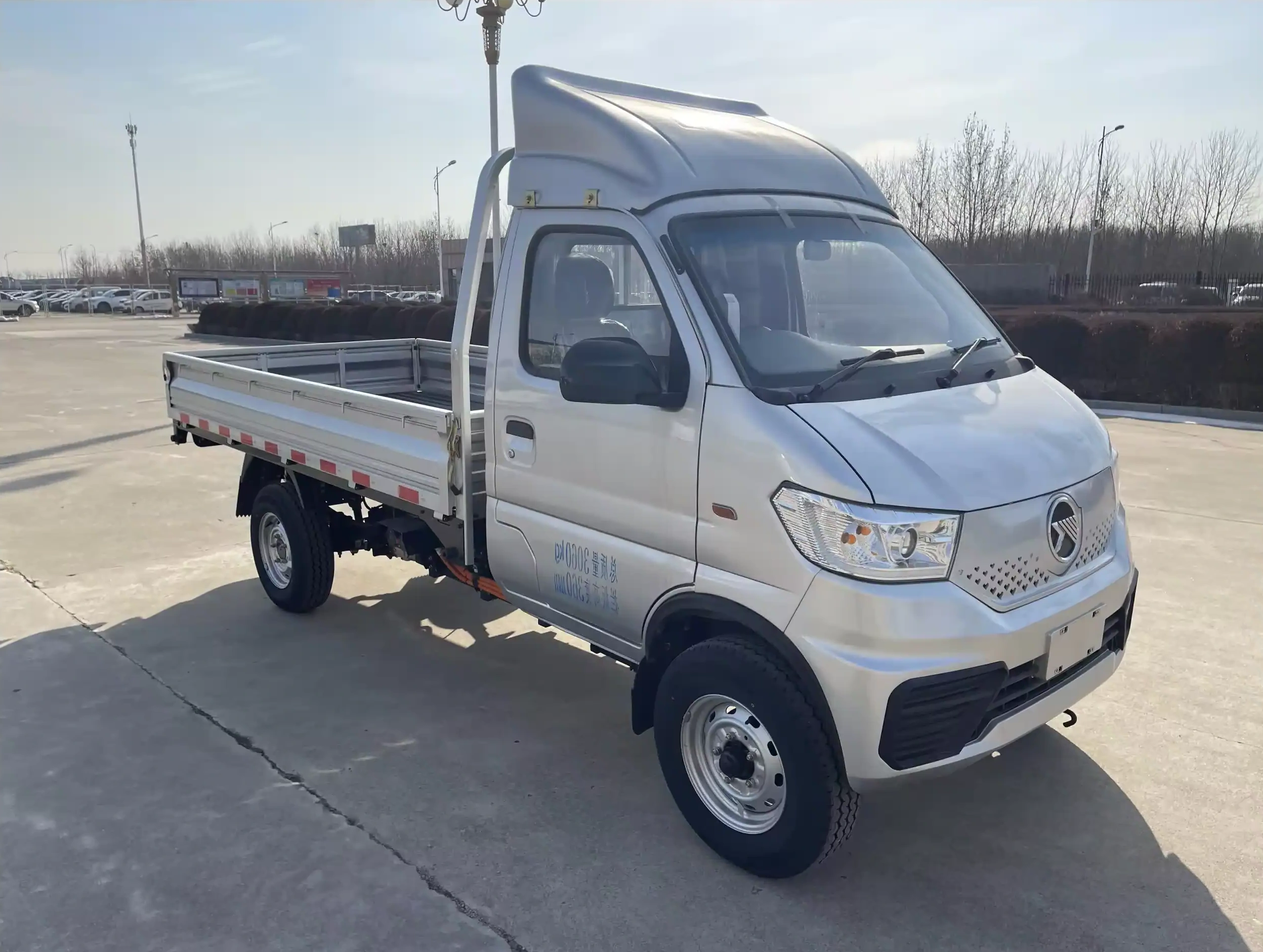
The KAMA EV1 and EV1S are both available in RHD configuration as an optional factory upgrade . This makes them immediately deployable in Kenya without conversion or compliance risk.
Here is why the EV1 series is particularly well-matched to Kenya's current market needs:
Urban last-mile delivery: Nairobi's logistics density is growing alongside e-commerce. Operators need compact, maneuverable trucks that fit within CBD access zones. The EV1's overall dimensions of 4,960 × 1,780 × 2,055 mm (single cabin) handle urban routes efficiently.
Agricultural and peri-urban supply chains: Kenya's inter-county produce logistics — connecting farms in the Rift Valley, Central, and Western regions to Nairobi markets — runs on light trucks. The EV1's 1.5-ton payload handles standard produce cargo, while zero fuel cost dramatically improves margins on routes where fuel has historically eaten into profitability.
Government and institutional fleets: With 3,000 government units already in procurement, institutional buyers are actively evaluating suppliers. A structured B2B proposal using the EV1S double-cabin configuration opens doors for staff transport and multi-function government use cases.
KAMA EV1 Series: Full Specifications for Kenya Procurement
The following specifications are drawn directly from current factory sheets. All models are BEV (Battery Electric Vehicle), HS Code 8704600000.
EV1 — Single Cabin, Standard Wheelbase
| Specification | Detail |
|---|---|
| Suggested payload | 1.5 T |
| Cabin | Single cabin |
| Wheelbase | 3,050 mm |
| Overall dimensions | 4,960 × 1,780 × 2,055 mm |
| Cargo box size | 3,050 × 1,690 × 360 mm |
| Curb weight | 1,500 kg |
| GVW | 3,050 kg |
| Max speed | 90 km/h |
| Range (WLTP) | 260 km |
| Battery pack | 41.932 kWh — LFP (Lithium Iron Phosphate) |
| Battery brand | GOTION |
| Charger type | Fast / Slow (GBT standard) |
| Motor | Wuhan Lincontrol, 35 kW rated / 70 kW peak |
| Tyres | 185R14LT (4+1) |
Standard configurations: ABS, power steering, A/C, MP5 media, power window, central lock.
Warranty: Motor, battery, control — 5 years or 200,000 km. Complete vehicle — 2 years or 40,000 km (excluding vulnerable parts).
EV1S — Double Cabin, Extended Wheelbase
The EV1S adds a rear passenger bench, making it suitable for crew transport, supervisory roles, and government multi-function use.
| Specification | Detail |
|---|---|
| Suggested payload | 1.5 T |
| Cabin | Double cabin — LHD standard (RHD +$850) |
| Wheelbase | 3,450 mm |
| Overall dimensions | 5,460 × 1,715 × 2,100 mm |
| Cargo box size | 2,350 × 1,625 × 360 mm |
| Curb weight | 1,600 kg |
| GVW | 3,150 kg |
| Range (WLTP) | 300 km |
| Battery pack | 51.46 kWh — LFP (GOTION) |
Battery upgrade option
EV2 and EV2S — Extended Wheelbase Variants
For distributors needing a larger cargo footprint:
| Model | Wheelbase | Range | Battery | |
|---|---|---|---|---|
| EV2 | 3,450 mm | 300 km | 51.46 kWh (GOTION) | |
| EV2S | 3,450 mm | 310 km | 53.58 kWh (CATL) | |
| EV3 | 3,450 mm | 310 km | 53.58 kWh (CATL) |
EV2S and EV3 use CATL battery cells — a premium specification increasingly demanded by institutional buyers who require bankable battery brand credentials for fleet financing.
Total Cost of Ownership: The Case for Kenyan Fleet Operators
Understanding the duty-free window requires understanding why it matters beyond the import price. Here is a simplified TCO comparison for a delivery operator running a single light truck on a Nairobi–Nakuru route (approx. 160 km per day):
Fuel cost (diesel 3-ton light truck):
Fuel consumption: ~12 liters/100 km
Daily fuel cost at current Kenyan diesel prices (~KES 165/liter): KES 3,168 per day
Annual fuel cost (300 operating days): KES 950,400 (~$7,300 USD)
Charging cost (KAMA EV1 on Kenya Power e-mobility tariff):
Consumption: ~16 kWh/100 km
Daily charging cost at KES 20/kWh: KES 512 per day
Annual charging cost (300 operating days): KES 153,600 (~$1,180 USD)
Fuel savings per truck per year: ~$6,120 USD
With a purchase price difference of approximately $3,000–5,000 USD between a comparable diesel truck and the EV1 (now reduced further by the duty exemption), the EV1 reaches break-even within 12 months under this scenario — and continues generating operational savings for the remaining 4+ years of the warranty period.
This is the calculation that Kenyan logistics operators are beginning to run. Distributors who can present this clearly in their sales conversations will close significantly faster.
Import Process: How to Structure a Kenya EV1 Order
For distributors and importers new to the Kenya EV import process, the following outlines the standard flow for a KAMA EV1 order under the current duty-free policy.
Step 1 — Product confirmation and RHD specificationConfirm model (EV1 / EV1S / EV2 / EV2S), cabin configuration, battery size, and body type (flatbed or cargo box). Specify RHD. Production time: 50 days from order confirmation.
Step 2 — Documentation packageKAMA provides: commercial invoice, packing list, bill of lading, certificate of origin (China), MSO/COP for Kenya KRA registration, and technical specification sheet for NTSA type approval submission.
Step 3 — HS Code and duty-free declarationHS Code: 8704600000 (motor vehicles for transport of goods, electric). Under President Ruto's May 2026 declaration, import duty is 0% for the first 100,000 EV units. Confirm the current duty status with Kenya Revenue Authority at time of clearance, as the policy is administered on a unit-count basis.
Step 4 — ShippingFOB Shenzhen. Standard container fit: 3 units per 40HQ for EV1; 2 units per 40HQ for EV1S. Sea transit to Mombasa: approximately 22–28 days.
Step 5 — Port clearance and NTSA registrationClear through Mombasa Port under the EV duty-free declaration. NTSA registration requires type approval documentation — KAMA's export team supports this with English-language technical files.
Step 6 — After-sales setupKAMA provides remote video technical training for local technicians. Spare parts supply is coordinated through the regional export system. CSS2 charge plug is standard; slow charging gun (AC MAX 6.6 kW) available as +$100 option.
SKD Assembly Option: For Local Content and Policy Alignment
The government's preference for "locally assembled" EVs (as stated in the 3,000-vehicle procurement) signals that SKD (semi-knocked-down) assembly partnerships will increasingly be favored in government and institutional procurement.
KAMA offers SKD packages at +$350 USD per unit (MOQ 4 units). The SKD kit includes: cab assembly, engine/transmission, front axle, rear axle, and cargo box. Remaining structural frame parts ship on the frame.
For Kenyan distributors with existing workshop facilities, or for those considering a local assembly JV, this creates a route to both lower import duty exposure on components (typically lower than CBU duty rates) and eligibility for government procurement preferences for locally assembled units.
Why Act Now: The 100,000-Unit Window
The duty exemption is capped at 100,000 units. Kenya registered approximately 35,000 EVs total by early 2026 — meaning the duty-free pool has substantial room remaining. However, that count includes motorcycles and three-wheelers, which dominate Kenya's EV fleet (approximately 90% of registrations). Commercial vehicle importers are competing for the same ceiling.
As awareness of the policy spreads across the region, import volumes will accelerate. Distributors who establish supply chains, secure factory partnerships, and complete initial shipments within the next 60–90 days will be better positioned than those who wait for the market to fully price in the opportunity.
The 12-month extended warranty option (2% of truck price) and logo customization (MOQ 4 units, +$200) allow distributors to white-label or co-brand units for Kenyan institutional buyers — a detail that matters when presenting to fleet managers who want a locally identifiable product.
Next Steps
KAMA Auto exports to 40+ countries across Africa, Latin America, Southeast Asia, and the Middle East, with 80% year-on-year export growth recorded in 2025. The EV1 and EV1S are export-ready with English-language documentation, RHD factory configuration, and established FOB logistics from Shenzhen.
To request a formal quotation, model comparison sheet, or discuss distributor partnership terms for Kenya or East Africa:
WhatsApp: +86 13603996917
Email: [email protected]
Website: www.kamaauto.cn/product/
Production slots for Q3 2026 are available. With a 50-day production cycle, orders placed before end of June ship ahead of peak Q4 logistics season.
KAMA Auto — Electric & Fuel Commercial Vehicles | CKD/SKD Export | 30+ Years Manufacturing | ISO 9001 Certified